
At puck drop it was one degree below zero Fahrenheit, about minus 18 Celsius, and the wind made it feel close to minus 30. Nobody left. On November 22, 2003, 57,167 people sat in the open-air bowl of Commonwealth Stadium in Edmonton and watched the Oilers and the Montreal Canadiens play the first regular-season game in NHL history held outdoors. Twenty-three years ago this coming Sunday, the league took a real game outside for the first time and found out what it had been missing.
These days an outdoor game is a fixture on the calendar. Back then it was a gamble. The ice could fail, the cold could empty the stands, and two points in the standings would be decided on a rink nobody had ever tested at that temperature in front of that many people.
A big idea in a cold city
The occasion was the Oilers' 25th season in the NHL and the 20th anniversary of their first Stanley Cup in 1984. College hockey had shown the way two years earlier, when Michigan and Michigan State drew a huge crowd to an outdoor game at Spartan Stadium known as the Cold War. The NHL itself had only played outside once before, a preseason exhibition between the Kings and the Rangers outside Caesars Palace in Las Vegas in 1991. Nothing that counted.
Gary Bettman gave it the green light anyway, and he made the case in the simplest terms. “Hockey started in Canada,” he said. “Playing outdoors was commonplace.” He also understood the appeal of the weather that everyone else was worried about: “We figured the colder the conditions, the stronger the bond.”
Edmonton took him at his word. The Oilers received 750,000 entries in the lottery for seats, according to NHL.com. Sports Illustrated put it another way: the stadium would have needed 900,000 seats to meet every request.
The legends went first
Before the real game came the one most of the crowd had really bought tickets for. The afternoon belonged to the alumni, billed as the MegaStars game: the Oilers of the 1980s dynasty against Canadiens greats led by Guy Lafleur. Wayne Gretzky pulled on an Oilers sweater for the first time since the 1987–88 season. Mark Messier, still an active player with the New York Rangers, needed the club's permission to take part, and got it.
It was played in two 15-minute halves, and it showed how hard the conditions were. The ice was brittle and flaky in the cold, and snow piled up because it wasn't resurfaced between halves. At one point Gretzky and Messier were shoveling snow over the boards themselves. Edmonton won 2–0 on goals from Ken Linseman and Marty McSorley. Messier called it “a typical Oilers win.”
Not everything went smoothly. Kevin Lowe pulled a groin early in the alumni game. Glen Sather, who coached the old Oilers again that day, joked that his players were heavier than they used to be. Dan Craig, the league's ice expert, later admitted the mistake of not resurfacing during the alumni game. His crew had to shave and flood the surface before the NHL teams could take it, and the main event started late.
“I didn't. I kept cold.”José Théodore, asked how he stayed warm
A toque on top of the mask
The picture everyone kept from that night is José Théodore. The Canadiens goaltender, who had won both the Hart and the Vezina Trophy in 2002, came out for warmups with a wool Canadiens toque pulled over his mask and kept it on for the whole game. He drank tea and hot chocolate to stay warm. His equipment went stiff in the cold, which made it hard to slide across his crease the way he normally did.
“My hands were really cold,” he said afterwards, “and my leg muscles tightened up.” At the other end, Ty Conklin started for Edmonton. The skaters had it only slightly better. Shawn Horcoff remembered the big heaters along the benches: “You would sit there, and your feet would be on fire.”
The teams dressed for the occasion. The Oilers wore the blue and orange of their WHA era, the Canadiens the colours of their 1946 Stanley Cup winners. Paulina Gretzky sang before the game, and Paul Lorieau sang the anthem in English and French with a choir.
The game itself
The first period ended 0–0, and for a while it looked like the cold might win. Then Richard Zednik scored 39 seconds into the second. Yanic Perreault added a power-play goal at 10:53, and Eric Brewer got one back for Edmonton at 13:45. Perreault scored again early in the third to make it 3–1.
The ending was the best part. In less than two minutes late in the third, the teams scored three times. Jarret Stoll pulled Edmonton within one at 13:06. Zednik answered at 14:18 for his second of the night, which would stand as the winner. Steve Staios made it 4–3 at 14:57, and the Oilers pushed for the rest of the game without finding the tying goal.
Seven goals in the cold
Every goal of the game on a 60-minute line. Montreal above, Edmonton below. Three of them came in the space of 1:51 in the third period.
Edmonton outshot Montreal 37–23. Théodore made 34 saves in his toque, and Perreault, Staios and Zednik were the three stars. The CBC broadcast drew 2.747 million Canadian viewers, the second-largest audience ever for a regular-season NHL game at the time, and it was the first NHL game the network showed in high definition.
The crowd that stayed
What people remember most is not the score. It's that the crowd stayed. Many had been in their seats since the alumni game in the afternoon, and they were still there at the end of a night game in the open air in late November in Alberta. Charlie Huddy, who played in the alumni game, said later that he couldn't believe the fans who “hung around for the whole time, it must have been so cold.”
One fan, a 32-year-old Edmontonian named Jeff Pederson, told Sports Illustrated what a lot of them seemed to feel: “The colder the better. Makes me feel tougher.” Steve Shutt, the old Canadiens winger, called it going back to shinny hockey, where people could just watch players play.
“The colder the better. Makes me feel tougher.”Jeff Pederson, a fan in the stands, to Sports Illustrated
What came after
Kevin Lowe, then the Oilers' general manager, saw where it was heading that same night. “I can foresee this being a great event in a lot of NHL cities,” he said, although he suggested trying October next time.
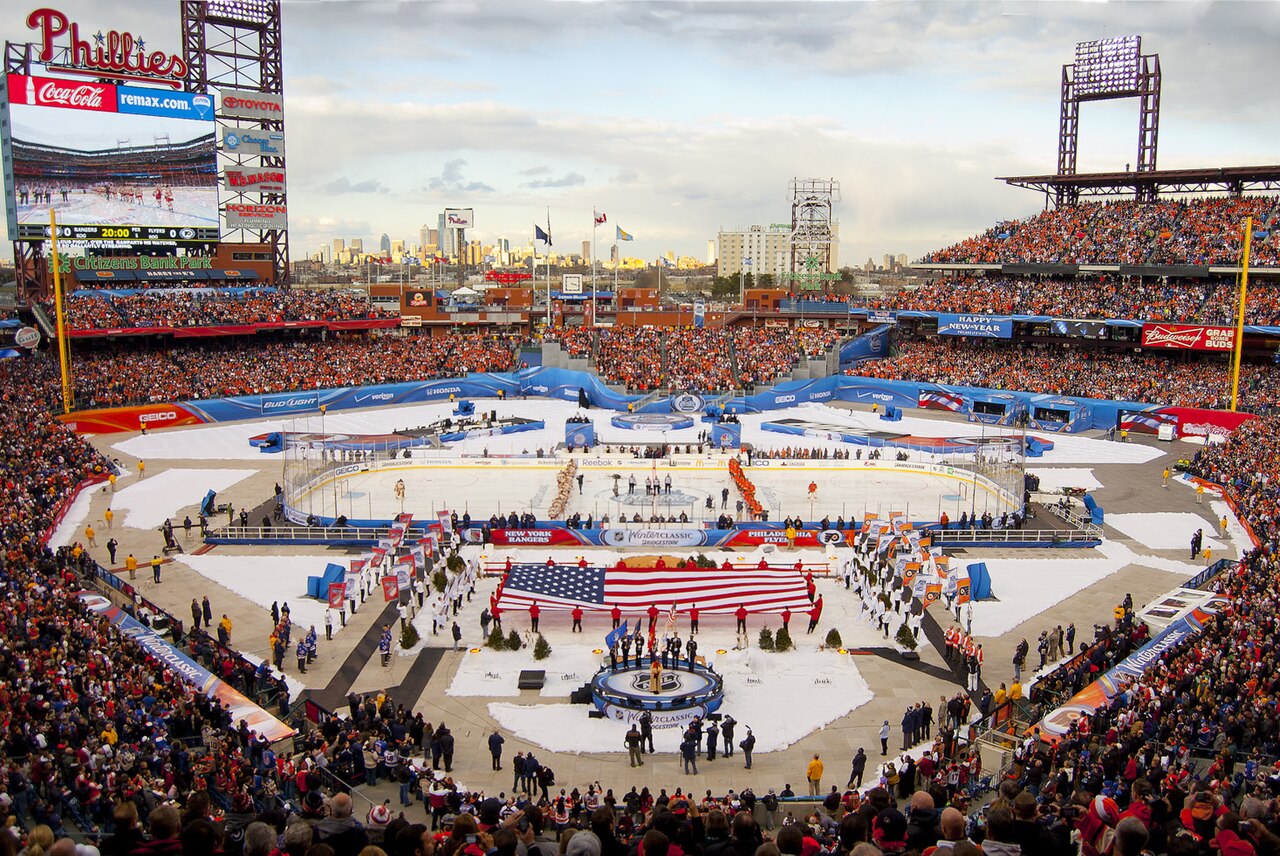
He was right about the cities. The league earned record sponsorship from the game and, by its own account, the highest revenue for a single event in its history to that point. Four years later came the first Winter Classic, on January 1, 2008, in the snow outside Buffalo. The goaltender who started for Pittsburgh that day was Ty Conklin, the same man who had been in the Edmonton net in 2003. The Heritage Classic returned in Calgary in 2011, then went on to Vancouver, Winnipeg, Regina and Hamilton. In 2023 it came back to Commonwealth Stadium, where the Oilers beat the Flames 5–2 in front of more than 55,000 people.
Outdoor games have become polished since then. Better ice, better weather planning, better heaters on the benches. But they all go back to that first night in Edmonton, a goalie in a wool hat and 57,167 people who could have gone home and didn't.